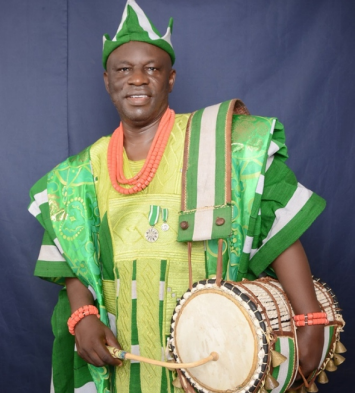
By the time Ayowumi Ayanwale Olayanju struck the talking drum before presidents, diplomats and international audiences, he had already spent decades preparing for the moment.
His journey began not in grand concert halls or international cultural centres, but in Akinmoorin, a quiet community in Oyo State where drumming was more than music – it was heritage.
Born into the renowned Agbelu drumming lineage, Olayanju grew up surrounded by the rhythms and oral traditions of the Yoruba people.
His father was a drummer; his mother was a chanter of Yoruba oral poetry. Before he entered primary school, he had already begun learning the art that w o u l d d e fi n e h is l if e ‘s work. What neither he nor his family knew then was that the same talking drum would one day become his passport to the world.
The LASU Years For Olayanju
Lagos State University was where raw talent met purpose. A member of LASU’s pioneer set, he graduated in 1988 with a degree in Yoruba Education, earning a Second Class Upper Division. Yet his university experience extended far beyond the classroom.
He became the first President of the Yoruba Students Association and immersed himself in cultural activities that celebrated indigenous heritage. He was also a member of the LASU Musical Ensemble established by the university’s pioneer Vice-Chancellor, Professor Folabi Olumide.
His LASU years were marked by youthful boldness and memorable adventures. One such episode occurred when he invited the Olojoo of Ojo to a Yoruba cultural celebration on campus without first informing university authorities. The resulting anxiety among administrators eventually ended with forgiveness and a valuable lesson in protocol.
Another incident saw him challenge a lecturer who refused to allow members of the university ensemble to make up a test they had missed while representing LASU at an official rehearsal. The matter
eventually reached the Vice-chancellor himself.
Looking back, these experiences helped shape a young man who would later navigate complex cultural and diplomatic environments with confidence.
Service Beyond Self
After graduation, Olayanju’s National Youth Service Corps year became a defining chapter. Rather than simply completing his service, he embarked on projects that reflected his passion for language, culture and education. He taught Yoruba literacy classes to adults, helped preserve Awori folklore, appeared on television programmes promoting indigenous culture and conducted research on local customs and traditions.The impact was extraordinary.
His initiatives earned NYSC honours at local, state and national levels and attracted simultaneous employment offers from both the Federal Government and LASU.
He eventually chose the Federal Civil Service – a decision that initially disappointed him but later proved pivotal. Years afterward, he would describe that turning point as destiny redirecting him toward a bigger stage.
His story is ultimately a testament to the power of identity. In an age when many young Africans are searching for relevance in a rapidly changing world, Ayanwale Olayanju’s life offers a compelling lesson:
Culture as Diplomacy
The Federal Ministry of Information and Culture became the platform from which Olayanju expanded his influence.
For more than two decades, he used the talking drum not merely as an instrument of entertainment but as a medium of cultural communication. His performances took him across continents. He accompanied presidential delegations, performed at UNESCO headquarters in Paris, participated in African Union events in Ethiopia, appeared at cultural gatherings in Cuba and China, and
represented Nigeria at numerous international festivals.
One of the highlights of his career came in 2007 when he
became the only African instrumentalist featured at the
“Concert for Dialogue Among Civilizations” in Havana,
Cuba. His mastery of the talking drum was opening doors
few could have imagined. Building Bridges in Brazil
Perhaps nowhere did Olayanju leave a deeper imprint than in Brazil. In 2009, he was appointed Pioneer Liaison Officer of the Nigerian Cultural Centre in Salvador, Bahia, a region where millions trace their ancestry to Yoruba-speaking West Africa.The
appointment was a natural fit. Armed with deep knowledge of Yoruba culture and extraordinary drumming skills, he became a living bridge between Nigeria and Afro-Brazilian communities eager to reconnect with their roots. He taught Yoruba language courses, organised drumming workshops, coordinated cultural exchanges and promoted Nigerian heritage across Brazil. His work earned recognition from Brazilian authorities and cultural organisations,
including an Award of Excellence from the State of Bahia. Through music, language and cultural education, he helped strengthen ties between two peoples separated by centuries but united by heritage.
From LASU to UNESCO
Olayanju’s reputation as a cultural expert eventually
led to his appointment as National Programme Officer for
Culture at UNESCO’s Regional Office in Abuja.There, he
contributed to programmes focused on preserving
intangible cultural heritage, promoting intercultural
dialogue and safeguarding traditional knowledge
systems.
He also played a role in the successful documentation
of the Ifa Divination System for UNESCO’s
Representative List of the Intangible Cultural Heritage of
Humanity. For a young man who once learned drumming
in village gatherings, it was a remarkable journey to the
forefront of global cultural preservation.
The Legacy of a Pioneer
Today, Olayanju is retired from public service,
having attained the rank of Deputy Director in the Federal
Ministry of Information and Culture. Yet retirement has
done little to slow him down. He continues to research
Yoruba heritage, write books, translate important works
into Yoruba, mentor younger generations and champion
cultural preservation initiatives in Nigeria and abroad.
His story is ultimately a testament to the power of identity.
In an age when many young Africans are searching for
relevance in a rapidly changing world, Ayanwale
Olayanju’s life offers a compelling lesson: the most
powerful route to global impact may begin with
embracing one’s roots. From the classrooms of LASU to
UNESCO offices, from Oyo’s drumming compounds to
presidential palaces and international festivals, he has
carried the sound of the talking drum across continents.
And in doing so, he has shown that culture is not merely
something to preserve – it is something powerful enough
to connect nations, shape destinies and speak to the world
Leave a Reply