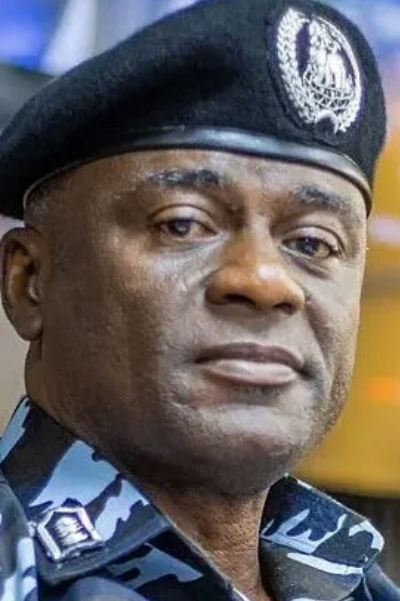
When President Bola Ahmed Tinubu appointed Tunji Disu as Nigeria’s 23rd Inspector-General of Police in
February 2026, the decision was widely interpreted as the culmination of more than three decades of policing
experience, strategic intelligence work, and operational leadership across some of the country’s most volatile security
environments.
For the Lagos State University Alumni Association community and graduates of Lagos State University, Disu’s
elevation represented something even deeper: another major national milestone for a university whose alumni
continue to shape governance, security, business, media, and public life in Nigeria.
From the bustling streets of Lagos Island where he was born on April 13, 1966, to the commanding heights of the
Nigeria Police Force, Olatunji Rilwan Disu’s story is one of persistence, discipline, reinvention, and public service.
LASU Roots and Academic Pursuit Before the stars and decorations, Disu was a student of Lagos State University, where he studied English Education. His academic journey did not stop there. He
later obtained a Master’s degree in Public Administration from Adekunle Ajasin University and another Master’s degree in Criminology, Security and Legal Psychology from LASU. Those who have followed his career closely often point to this unusual
combination of humanities, administration, and criminology as part of what shaped his communication style and operational philosophy.
Unlike many officers whose careers remain narrowly confined to field operations, Disu cultivated a reputation as a thinking policeman — one who combined operational toughness with strategic communication and human engagement. That combination would later define
many of his most visible assignments.
Joining the Police and Early Career Disu joined the Nigeria Police Force on May 18, 1992, beginning a career that would take him across multiple commands and sensitive security operations nationwide.
His early years saw him serve as Divisional Police Officer in Ago-Iwoye in Ogun State, Ikare and Owo in Ondo State, and later in Elelenwo and Elimbu in Rivers State.
These postings exposed him to the complexities of grassroots policing in both urban and semi-urban Nigeria at a time when armed robbery, communal clashes, and organized criminal activities posed major challenges.
He later rose through tactical and investigative units, serving in anti-kidnapping operations and the now defunct Special Anti-Robbery Squad (SARS) in Ondo, Oyo, and Rivers states. His years in Rivers State were particularly significant. The Niger Delta region at the time was experiencing militancy, cult violence, oil theft, and kidnapping. Officers who served there during that period often emerged battle-tested, and Disu was no exception.
International Exposure in Sudan One of the defining moments of his career came in 2005 when he led the first Nigerian Police contingent to the African Union Mission in Sudan (AMIS), a peacekeeping operation in the troubled Darfur region.
While serving in Sudan, he reportedly rose to become Acting Chief of Staff of the contingent before returning to Nigeria in 2006. The international assignment exposed him to multinational security coordination and crisis management — skills that would later prove valuable in high-pressure domestic assignments.
Rebranding the Police Image in Lagos
Perhaps no assignment projected Tunji Disu into national consciousness more than his tenure as Commander of the Lagos State Rapid Response Squad (RRS) between 2015 and 2021. At a time when public distrust of the police was growing nationwide, Disu attempted something unusual: rebranding officers under his command as “The Good Guys.” The slogan was more than a public relations
phrase. Under his leadership, the Rapid Response Squad (RRS) increased its visibility on social media, adopted
more citizen-friendly communication, and sought to project a more approachable image while maintaining operational effectiveness against crime The RRS under Disu became known for rapid deployment against robbery gangs, traffic-related
criminal activities, and cult violence in Lagos.
Many Lagos residents who encountered the squad during that era still remember the highly visible patrol structure and the strong emphasis on discipline and response time.
The Intelligence Response Team
Assignment
In August 2021, Disu was appointed head of the Police
Intelligence Response Team (IRT), succeeding the
controversial police officer Abba Kyari. The appointment
came at a delicate moment for the Nigeria Police Force.
The IRT had been severely damaged by controversy
surrounding Kyari’s suspension and subsequent legal
troubles. Disu’s assignment was therefore viewed not
merely as an operational deployment, but as an
institutional repair mission.
Security analysts observed that his relatively calm public
profile and disciplined operational background made him
a strategic choice to restore confidence in the unit.
Rivers State and the FCT: High-Stake
Commands
Disu later served as Commissioner of Police in Rivers State, one of Nigeria’s most politically sensitive and security-challenging states, before being redeployed as Commissioner of Police for the Federal Capital Territory (FCT), Abuja. Both positions tested his administrative
and operational capabilities. In Rivers State, he navigated a tense political environment often characterized by rivalry, protests, and security concerns linked to oil infrastructure and political actors. In Abuja, the nation’s capital, he faced increasing concerns over kidnappings, urban crime, and threats to critical institutions. His
handling of these assignments strengthened his profile as one of the most experienced operational officers in the force.
Appointment as Inspector-General of Police Following the resignation of Kayode Egbetokun, President Tinubu appointed Disu as Acting InspectorGeneral of Police on February 24, 2026. Presidential spokesman Bayo Onanuga said the appointment was made in view of “the current security challenges confronting the nation” and expressed confidence in Disu’s “operational expertise and proven leadership capacity.” The National Police Council subsequently
ratified his appointment as substantive Inspector-General
of Police.
Disu has emphasized professionalism,
intelligence-led policing,
discipline, community trust, and
technology-driven crime ghting as
pillars of his administration
On March 4, 2026, he was formally sworn in by President Tinubu at the Presidential Villa in Abuja. Vision for the Nigeria Police Force since
assuming ofce Disu has emphasized professionalism, intelligence-led policing, discipline, community trust, and technologydriven crime fighting as pillars of his administration, according to official statements surrounding his appointment and subsequent engagements. Observers believe his background in intelligence
operations and tactical policing is likely to shape his
approach to combating kidnapping, banditry, cybercrime, terrorism, and urban criminality.
His supporters also expect him to continue the citizenengagement approach that became associated with his years at the Lagos RRS. In many ways, his emergence reflects a broader shift within the Nigeria Police Force toward officers with strong operational credentials,
communication skills, and public-facing leadership styles.
A Symbol of LASU’s Growing National
Inuence
For Lagos State University, Disu’s ascent adds to the
growing list of alumni occupying strategic national
positions.From politics and law to media, technology,
entertainment, and public administration, LASU
graduates increasingly occupy influential spaces in
Nigeria’s national life.
Disu’s journey from LASU classrooms to the office of
Inspector-General of Police now stands as one of the
institution’s most powerful public service stories. It is
also a reminder that leadership pathways can emerge
from persistence, continuous learning, and decades of
disciplined service.
For younger LASU students and alumni, his story offers a
compelling message: national relevance is not always
built overnight. Sometimes, it is earned assignment after
rigorous service and assignment, command after
command, year after year. And in Tunji Disu’s case, the
journey from LASU graduate to Nigeria’s Number One
cop has become one of the defining Nigerian public
service stories of the moment.
Leave a Reply